Skip to content
West Vancouver · Surgeon-Led

Upper
Blepharoplasty.

Lighter, brighter, more open eyes. Upper eyelid surgery personally performed by Dr. Eli Akbari — double board certified facial plastic surgeon.
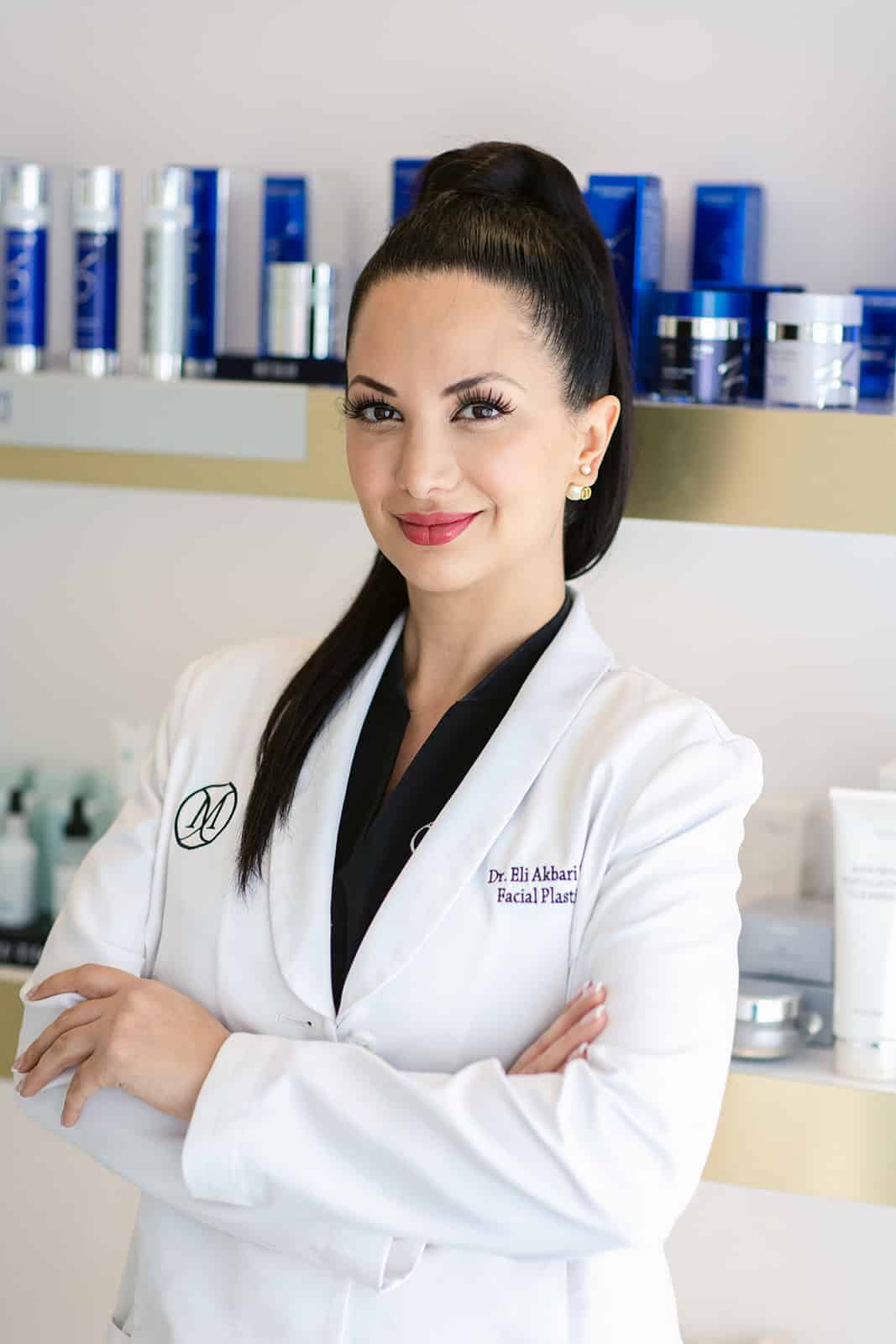
Dr. Eli Akbari, double board-certified facial plastic surgeon in West Vancouver
Fig. 1 — Upper Eyelid Surgery
01
What It Does

Lift.
Open.
Refresh.

01
Removes Excess Skin
Takes away the heavy, hooded skin that folds over the eyelid crease.
02
Opens the Eyes
Restores a defined, natural crease so the eyes look brighter and more awake.
03
Hidden Scar
The incision sits in the natural eyelid crease, where it fades and is well concealed.
Surgical Precision

A rested look
that stays you.

"The goal of eyelid surgery is that people tell you that you look well-rested — not that you had surgery."

Upper blepharoplasty is surgery to remove excess skin — and, when needed, a small amount of fat or muscle — from the upper eyelids. With age, eyelid skin stretches and can fold over the natural crease, making the eyes look heavy, tired or older than you feel, and sometimes getting in the way of your upper field of vision.

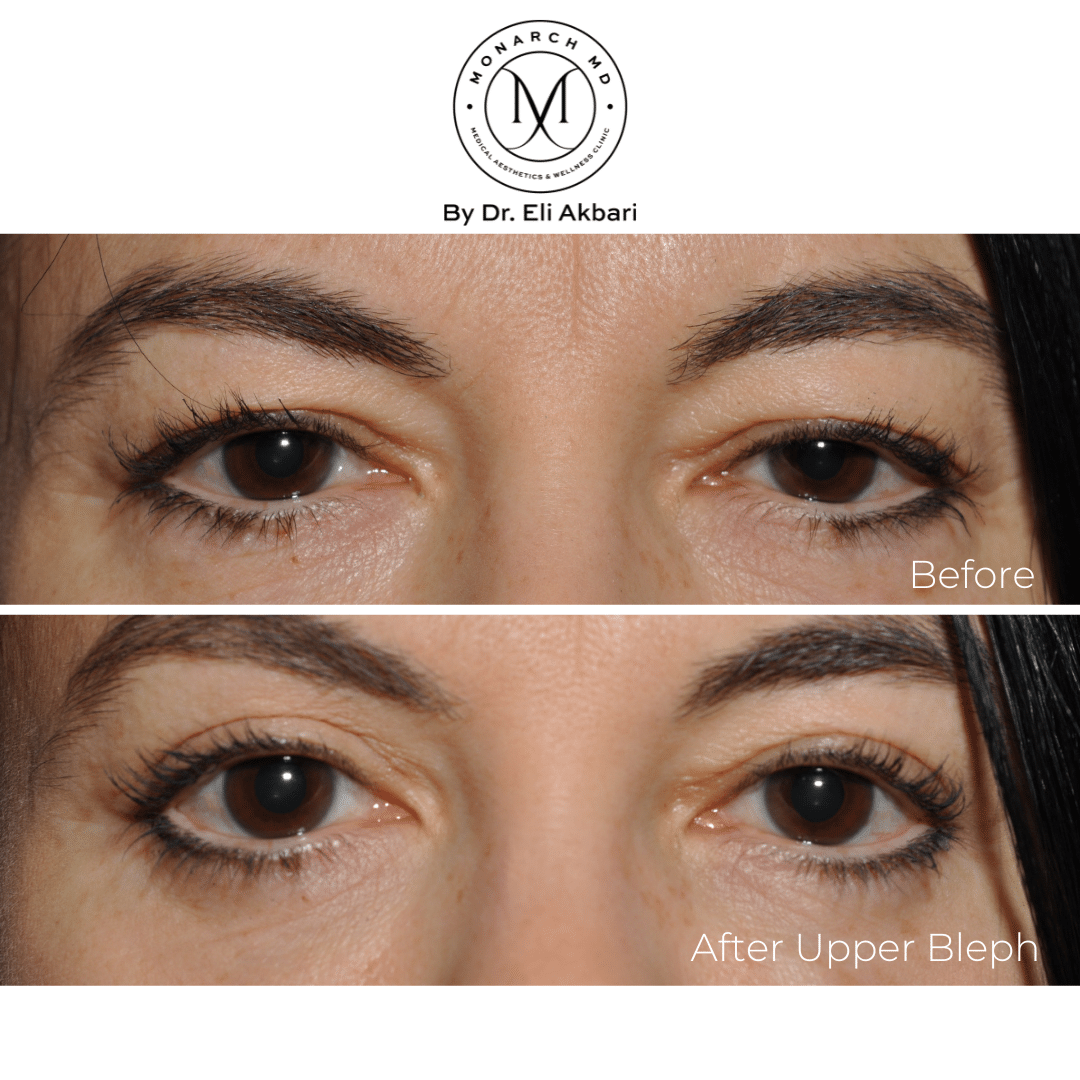
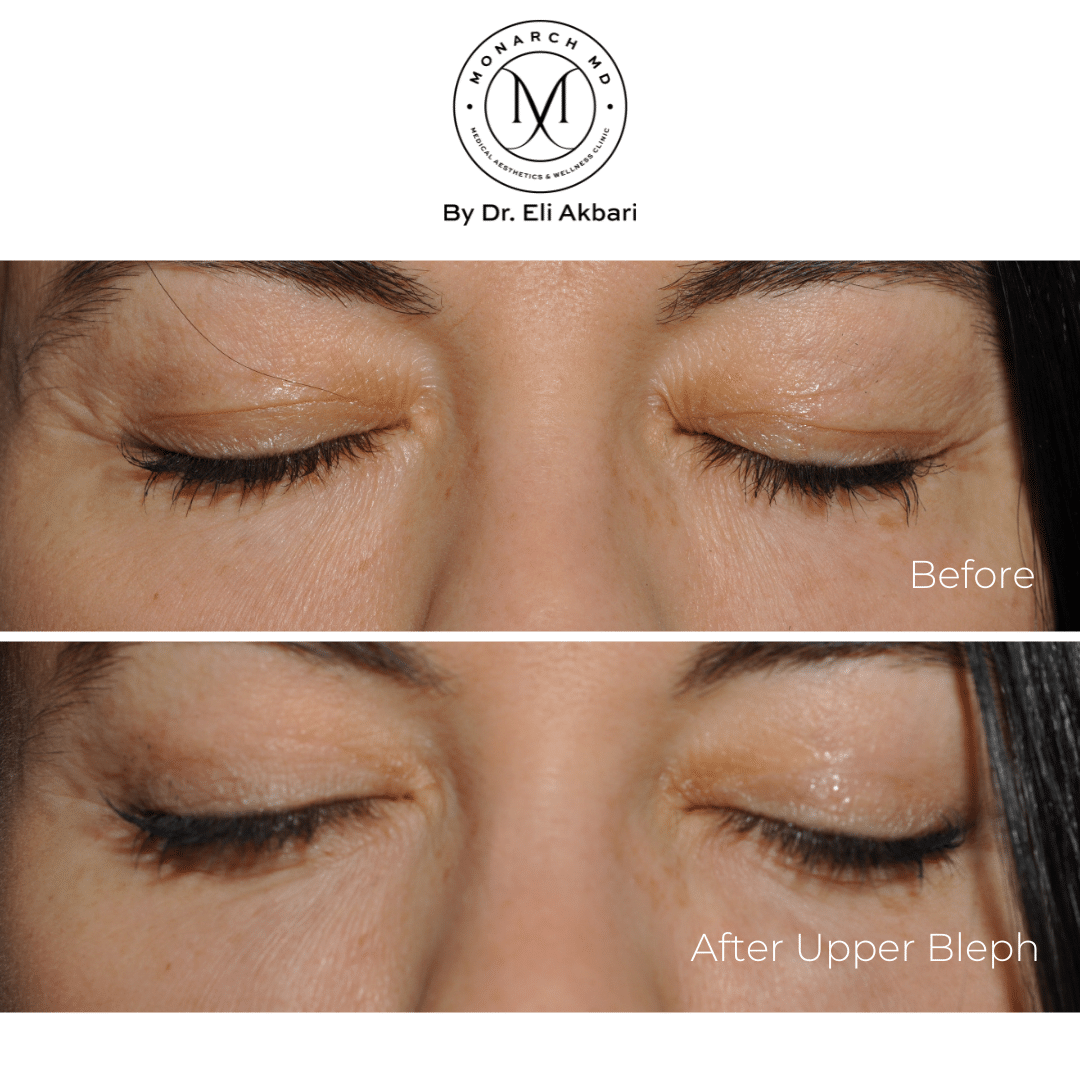
The incision is placed in the natural eyelid crease, so once healed the scar is very well concealed. The aim is a natural result: eyes that look refreshed and open while keeping their own shape and character.

Eyelid and facial anatomy is the core of Dr. Eli Akbari's training as a double board certified facial plastic surgeon. She personally assesses and performs every upper blepharoplasty at Monarch MD.

~1 hr
Procedure Time
Typical for upper eyelids alone; varies by patient
7–10
Days Social Downtime
Most bruising and swelling settles in this time
2×
Board Certified
Facial plastic surgeon — RCPSC · AAFPRS
Hidden
Crease Incision
Placed in the natural fold of the eyelid
Results Gallery

Before & After.

Book a Consultation
Upper blepharoplasty before and after by Dr. Eli Akbari, eyes open
Upper blepharoplasty before and after by Dr. Eli Akbari, eyes closed showing the healed crease incision
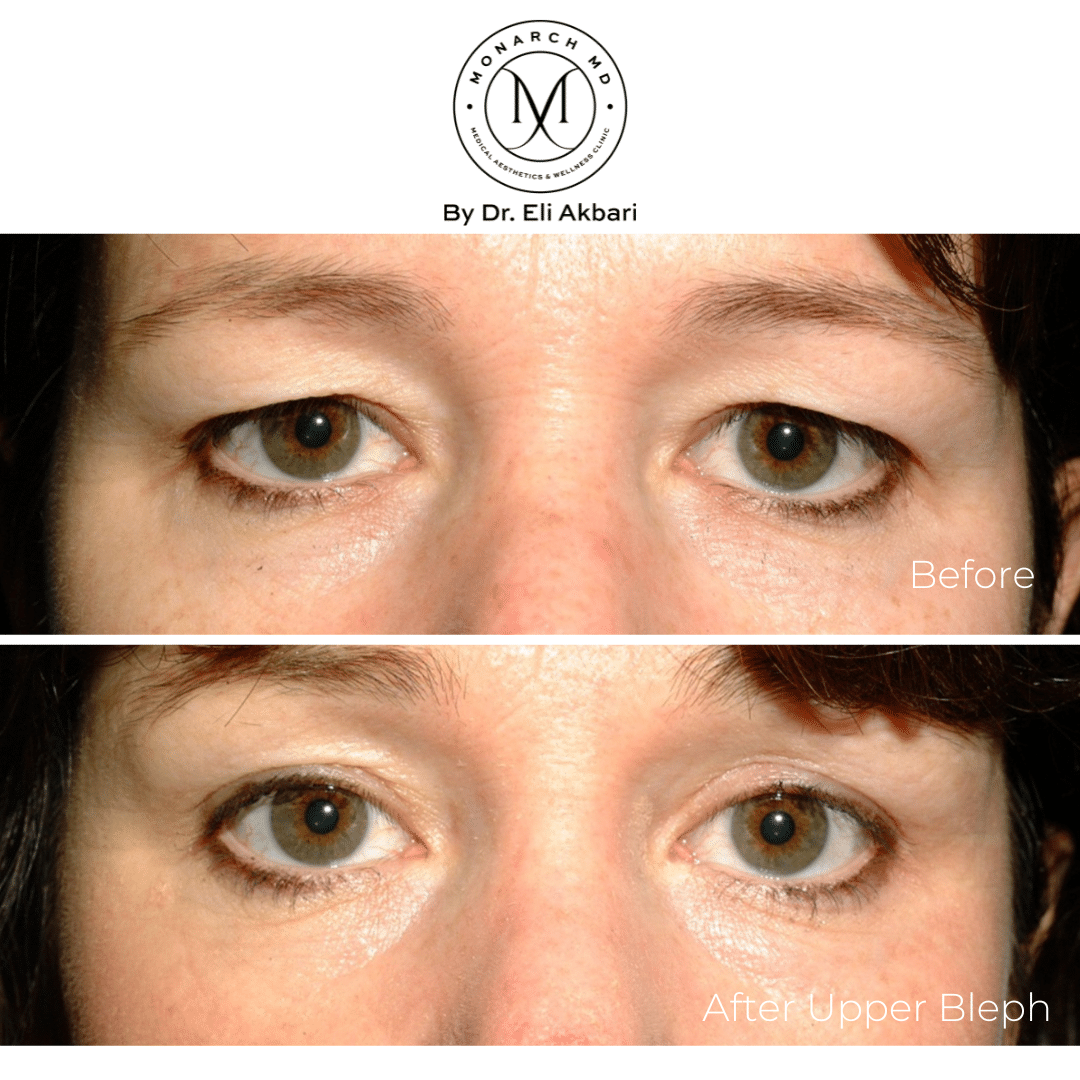
Upper eyelid surgery before and after at Monarch MD, West Vancouver

Individual results may vary. All procedures personally performed by Dr. Eli Akbari, MD, FRCSC.

What It Treats

Concerns upper eyelid
surgery can address.

01
Hooded Eyelids
Skin that hangs over the crease and hides the eyelid when your eyes are open.
02
Heavy, Tired Look
Eyes that look tired or older even when you are well rested.
03
Skin on the Lashes
Excess skin that rests on the lashes or presses down on the upper lid.
04
Inner-Corner Puffiness
Fullness near the nose caused by a small fat pad that can be reduced.
05
Makeup Creasing
Eyeshadow that smudges or disappears into a folded upper lid.
06
Obstructed Vision
Heavy lids that block the top of your field of vision.
Is This Right for You

Upper eyelid
surgery may be right
for you if —

Excess upper eyelid skin makes your eyes look heavy, hooded or tired.
Skin folds over your eyelid crease or rests on your lashes.
You are in good general health and do not smoke, or are willing to stop around surgery.
You want a long-lasting, natural improvement that non-surgical treatments can't give.

Not sure if surgery is right for you? Book a consultation — Dr. Akbari will tell you honestly whether eyelid surgery, a brow treatment or a non-surgical option suits you best.

Heavy-looking eyes aren't always caused by eyelid skin. A low brow, or a weak muscle that lifts the eyelid (ptosis), can look similar and need a different approach. Part of your consultation is working out exactly which is responsible.

Dr. Akbari will also review your eye health — including dry eye, prior eye surgery and conditions such as thyroid eye disease — and your medications before recommending surgery. For mild hooding, options like a Botox brow lift may be discussed honestly as an alternative.

Upper and Lower Eyelids

This page covers the upper eyelids. Under-eye hollows and bags are a different concern; Dr. Akbari will discuss the right options for the lower lids at your consultation.

Dr. Eli Akbari with her surgical credentials at Monarch MD
Fig. 2 — Surgeon-Led Care
The Process

Your surgery,
step by step.

01
Consultation
Dr. Akbari examines your eyelids, brows and eye health, takes photos and explains what surgery can and cannot achieve for you.
02
Planning
The amount of skin (and any fat) to remove is carefully planned and marked so both sides are balanced.
03
Anaesthesia
Upper blepharoplasty is commonly performed under local anaesthetic, sometimes with light sedation. Dr. Akbari will explain the plan for you.
04
Surgery
Excess skin, and fat if needed, is removed through an incision in the natural crease, then closed with fine stitches.
05
Aftercare
You go home the same day with cold compresses, eye care instructions and a follow-up plan.
06
Follow-Up
Stitches are typically removed about a week later, and your healing is reviewed over the following weeks.
What to Expect

Recovery & healing timeline.

First Week
5–7 days
Swelling and bruising peak in the first few days. Cold compresses, rest and keeping your head elevated help. Stitches typically come out around day five to seven.
Back to Routine
10–14 days
Most bruising has faded and many people return to work and social plans. Avoid strenuous exercise and eye makeup until you are cleared.
Final Result
2–3 months
Remaining swelling settles and the scar continues to soften and fade over the following months.
Why Monarch MD

The standard of
eyelid surgery care.

I
Facial Plastic Surgeon
Dr. Eli Akbari is a double board certified facial plastic surgeon (RCPSC · AAFPRS) trained at UBC and the University of Toronto, with a focus on the face and eyelids.
II
Natural Results
Conservative, balanced surgery that refreshes the eyes while keeping their natural shape — never a surprised or "operated" look.
III
Honest Assessment
If your heaviness comes from the brow or eyelid muscle, or a non-surgical option would serve you better, Dr. Akbari will tell you.
IV
One Surgeon Throughout
The same surgeon assesses you, performs your procedure and follows your recovery.
Patient Experiences

What our patients
say.

"Dr. Eli Akbari is the best. She and her staff have a special way of making you feel important, cared for, and safe. She is truly passionate about enhancing your natural beauty, not changing your appearance."

Amanda B. — Patient

"Everything about this experience was beyond positive. An incredibly client-centred team with so much expertise — you truly feel like you're in the best hands possible."

Sarah J. — Patient

"Dr. Eli is amazing — like a sculptor. She treated me like family, yet was so professional and talented. She took time to explain every detail. I wouldn't trust anyone else."

Mark T. — Patient

"Dr. Akbari was very attentive, professional, and knowledgeable. She took time to explain procedures in detail while being caring and understanding. Highly recommend for any cosmetic enhancement."

Emily R. — Patient
Frequently Asked

Your questions,
answered.

It is surgery to remove excess skin, and sometimes a small amount of fat or muscle, from the upper eyelids. It reduces hooding and gives the eyes a more open, rested look.
The incision is placed in the natural crease of the upper eyelid. It is pink at first and fades over the following months, becoming very well concealed in most patients.
The eyelids are numbed during surgery. Afterwards most patients describe tightness and mild discomfort that is usually well controlled with simple pain relief and cold compresses.
Most bruising and swelling settles within about 10 to 14 days, and many people return to work in that time. Final results are seen after a few months as the last swelling settles.
Usually after your stitches are out and the incision has healed — typically one to two weeks. Dr. Akbari will tell you when it is safe for you.
Results are long-lasting. Skin continues to age naturally, but most patients enjoy the improvement for many years.
As with any surgery, risks include bleeding, infection, asymmetry, temporary dry or irritated eyes, and scarring. Serious complications are uncommon. Dr. Akbari will go through these with you at your consultation.
Good candidates are healthy adults with excess upper eyelid skin, realistic goals, and no uncontrolled eye or medical conditions. Smoking slows healing and should be stopped around surgery.
Cosmetic eyelid surgery is not covered by MSP. If heavy eyelids affect your vision, mention it at your consultation.
Every upper blepharoplasty is customized to what your eyelids need, so your surgical plan is tailored and depends on your initial consultation with Dr. Akbari.

Related: Botox Brow Lift · Dermal Fillers · 4D Laser Facelift · Morpheus8 · About Dr. Akbari

Check Pricing

Fill out the form below, and we will be in touch shortly.

Select all services you're interested in